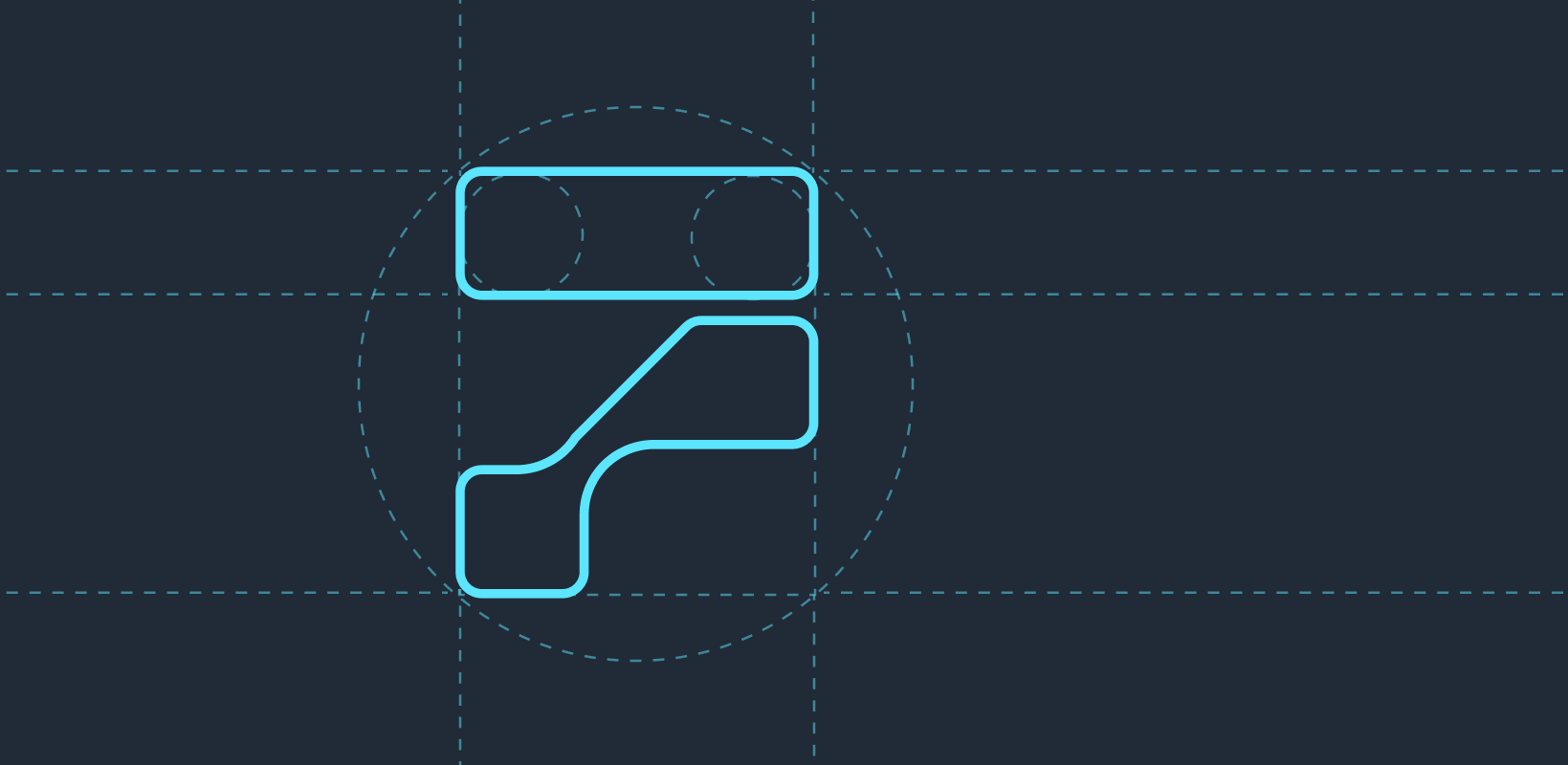

Fast forward to today, and we're a team of 50+ and a Webflow Enterprise Partner, working with companies like Stripe, Kajabi and PayPal. With that much change, refreshing a few pages wasn't going to be enough. So we rebuilt the whole thing, identity included.
We'd outgrown our own brand
Our first brand was put together fast, and it kept up with our tempo and all our changes really well. It brought in our first clients, and then the next hundred.
But we work with a different kind of client now, much bigger ones, the ones that are shaping and leading in their market. So when a VP of Marketing lands on our site, we want them to see the team they'd actually be working with, and the results they can expect. To get there, we did something that might sound a bit backwards: we made ourselves quieter.
Look around the Webflow space and you'll see a lot of agencies leaning heavily on blue and gradients. We wanted to do something that felt more our own. We moved to white, gray and charcoal, and kept cyan for the moments that really matter. You'll find it on buttons, play controls and the small signals that invite you to explore.
With a calmer palette, typography gets to do more of the talking, and that's where Roobert, our new typeface, comes in. It has so much character that it carries a lot of the brand on its own.
Of course, nothing better comes without a small sacrifice. Our old purple-and-cyan Slack emoji, the one that showed up for every big company announcement and milestone, is retiring too. It will be missed.
All this restraint has a purpose: it lets each client project bring its own colors, imagery and personality, without competing with the Flowout brand.
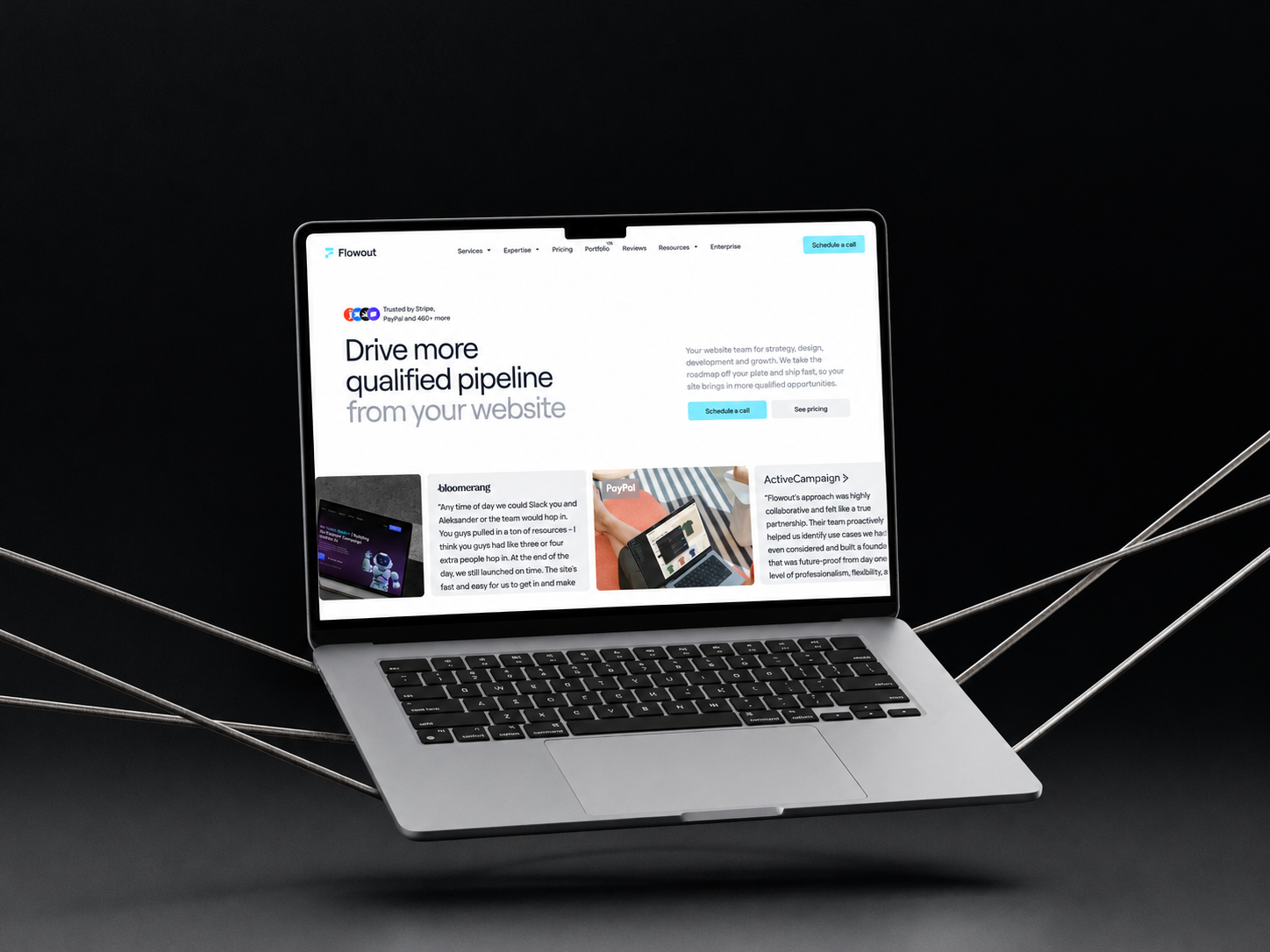
Same people, start to finish
A new logo can tell you a lot, but not how a team works. So here's that part: we're a fixed, connected in-house team. Design, development, copy, SEO and growth all sit under one roof, so if you need to add a page or an integration a year later, the same team will be there for you.
Having everyone in one place lets us take on the big projects, whether it's a migration, a redesign or a whole new website, along with all the complicated stuff that comes with them: complex integrations, multi-market sites, enterprise security and governance. As we move upmarket, we wanted to say that clearly, so the new site is a lot more direct about who we are, what we do and how we do it.
Which brings us to the question we hear in almost every conversation lately.
About AI (because everyone's asking)
Yes, AI is changing how websites get made. Anyone can generate a page, a layout or a block of copy in minutes now. We use it every day too, and it makes us a lot faster.
But here's the thing. For an enterprise company, a website is never just about producing pages. It's about what those pages do: a qualified pipeline, a brand that holds up across markets, a migration that keeps its traffic, a platform your marketing team can actually run.
Getting there means knowing which decision will come back to bite you six months later, which integration will break under real load, and what your legal, security and sales teams will ask before they sign off. You get that from a team of experts doing the work for companies like yours.
AI speeds up the work, and experience gets it right. Putting both to work on our own site, though, was another story.
What it's like being your own client
We redesign websites for a living, so you'd think doing our own would be easy. Suddenly we were the ones signing off on the positioning, debating every section, every headline, every animation.
The longest debate? Which projects get the spotlight. Put a designer, a developer and a CEO in front of the same project and you'll hear three different stories, each one worth telling. Picking between them was harder than any layout decision.
And then came the night before launch, when we shared the links over Slack for everyone to test and click through, just in case.
It all reminded us of something we already knew, but now really felt. A redesign is never just a website project. It's your brand, your pipeline and your first impression, all changing at once. And so much of it comes down to how much you trust the people doing the work.
We get it now, from the inside. We know what's on the line when you decide to make a change like this, and we don't take that lightly.
Launch is just the beginning
And once the site is live, the work doesn't stop. For us, that's where things get interesting.
Our previous website was our very first one, and it worked hard for us, growing with every new service, project and idea we tested over five years. This time, we took everything we've learned along the way and gave the new site a simpler, clearer structure. We also made it faster, because performance is something we obsess over for every client, and our own site deserved the same treatment. What we ended up with is a foundation we can keep building on.
Our marketing team is most excited about the growth experiments they can run after launch. The new website gives us a much better base, so we can test ideas faster, do them better and use AI to help along the way.
We think about client sites the same way. A website you can measure, test and keep improving is worth far more than one that's simply "done."
We're still us
At the end of the day, we're a team that likes working together, having fun and, every now and then, trying to beat each other at something.
We didn't want a more serious website to lose that, so we hid a little of it where you'd least expect it. Land on a page that doesn't exist, and you'll find a game of Snake waiting on our 404 page. Go on, see how long you last.
So, what's next?
This website is a snapshot of how far we've come in five years: from three desks in three apartments, lights off at 4 am, to a team trusted by market leaders we look up to.
It's also a peek at where we're headed. These days that means migrating sites with hundreds of pages, and helping companies with more than 50 years of history take the next step in their brand. Bigger projects, harder problems, and the same team accountable for the results.
So have a look around. And if you're planning a redesign, migration or full rebuild of your own, let's talk. We've just been through one, so we know how it feels, and what it takes to get it right.